Friday, 30 June 2017

ASP.NET Technology Project : Does Saas have ASP.NET Solution

What is Entity Framework?

Writing and managing ADO.Net code for data access is a tedious and monotonous job. Microsoft has provided an O/RM framework called "Entity Framework" to automate database related activities for your application.
Microsoft has given the following definition of Entity Framework:
The Microsoft ADO.NET Entity Framework is an Object/Relational Mapping (ORM) framework that enables developers to work with relational data as domain-specific objects, eliminating the need for most of the data access plumbing code that developers usually need to write. Using the Entity Framework, developers issue queries using LINQ, then retrieve and manipulate data as strongly typed objects. The Entity Framework's ORM implementation provides services like change tracking, identity resolution, lazy loading, and query translation so that developers can focus on their application-specific business logic rather than the data access fundamentals.
Entity framework is an Object/Relational Mapping (O/RM) framework. It is an enhancement to ADO.NET that gives developers an automated mechanism for accessing & storing the data in the database.
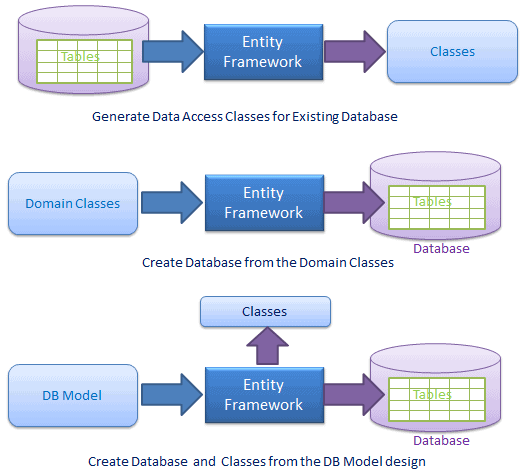
Entity framework is useful in three scenarios. First, if you already have existing database or you want to design your database ahead of other parts of the application. Second, you want to focus on your domain classes and then create the database from your domain classes. Third, you want to design your database schema on the visual designer and then create the database and classes.
The following figure illustrates the above scenarios.
Entity Framework overview
As per the above figure, EF creates data access classes for your existing database, so that you can use these classes to interact with the database instead of ADO.Net directly.
EF can also create the database from your domain classes, thus you can focus on your domain-driven design.
EF provides you a model designer where you can design your DB model and then EF creates database and classes based on your DB model.

What is O/RM?

ORM is a tool for storing data from domain objects to relational database like MS SQL Server, in an automated way, without much programming. O/RM includes three main parts: Domain class objects, Relational database objects and Mapping information on how domain objects map to relational database objects (tables, views & storedprocedures). ORM allows us to keep our database design separate from our domain class design. This makes the application maintainable and extendable. It also automates standard CRUD operation (Create, Read, Update & Delete) so that the developer doesn't need to write it manually.
A typical ORM tool generates classes for the database interaction for your application as shown below.

Entity Framework overview
Visit wikipedia for more information on Object-relational Mapping
There are many ORM frameworks for .net in the market such as DataObjects.Net, NHibernate, OpenAccess, SubSonic etc. Entity Framework is an open source ORM framework from Microsoft.
Please note that Entity Framework is an open source framework by Microsoft. You can contribute to the Entity Framework project on codeplex.

Entity Framework Architecture

The following figure shows the overall architecture of the Entity Framework. Let us now look at the components of the architecture individually:
Entity Framework Architecture
EDM (Entity Data Model): EDM consists of three main parts - Conceptual model, Mapping and Storage model.
Conceptual Model: The conceptual model contains the model classes and their relationships. This will be independent from your database table design.
Storage Model: Storage model is the database design model which includes tables, views, stored procedures, and their relationships and keys.
Mapping: Mapping consists of information about how the conceptual model is mapped to the storage model.
LINQ to Entities: LINQ to Entities is a query language used to write queries against the object model. It returns entities, which are defined in the conceptual model. You can use your LINQ skills here.
Entity SQL: Entity SQL is another query language just like LINQ to Entities. However, it is a little more difficult than L2E and the developer will have to learn it separately.
Object Service:Object service is a main entry point for accessing data from the database and to return it back. Object service is responsible for materialization, which is the process of converting data returned from an entity client data provider (next layer) to an entity object structure.
Entity Client Data Provider:The main responsibility of this layer is to convert L2E or Entity SQL queries into a SQL query which is understood by the underlying database. It communicates with the ADO.Net data provider which in turn sends or retrieves data from the database.
ADO.Net Data Provider:This layer communicates with the database using standard ADO.Net.
is plural. For example, if SchoolDB has Students table name then entityset would be singular Student. Similarly, relationships between the models will be pluralized if the table has one-to-many or many-to-many relationship with other tables. For example, Student has many-to-many relationship with Course table so Student entity set will have plural property name 'Courses' for the collection of courses.speak to them about us.


Want to learn ASP.NET MVC 5 from scratch in a fun, step-by-step and pragmatic way? Watch this tutorial and you'll start coding in a few minutes. This tutorial series shows you how to create .NET Framework applications and components using the .NET Framework SDK. The development tools in the SDK use the .NET Framework to allow you to quickly build and deploy robust applications that take advantage of the new common language run-time environment.

        Smart Software Solutions Inc. is a computer consulting company headquartered in Pierre, South Dakota. The company was founded by Matthew Smart in 2004. Smart Software Solutions specializes in the creation and hosting of web based information management systems, dynamic websites, and custom applications for businesses of all sizes. Smart Software Solutions Inc. has a dedicated team of developers with the motivation and desire to write great software.
We are a highly skilled and energetic U.S. based software development team with a proven track record and our other business channels.


          This tutorial series shows you how to create .NET Framework applications and components using the .NET Framework SDK. The development tools in the SDK use the .NET Framework to allow you to quickly build and deploy robust applications that take advantage of the new common language runtime environment. Using the tools in the .NET Framework SDK provides the following four benefits:

        We deliver excellent service built upon an open dialogue with our clients. Our staff of 40 plus development engineers are experienced in all phases of software development. We have a very flexible skill-set.

        Part of redesigning and re-organizing strategy incorporated identifying what software they wanted to be able to present to their clients and visitors, and how that software would be formatted. We worked with them to produce a UX prototype that presented a more intuitive layout and navigation path through their site, bringing the software offerings into a central hub (called “Relationship Banker”), while making support and other resources easier to reach.


Master the fundamentals of C# and .NET using this simple, pragmatic and step-by-step tutorial for beginners. With C# you can build mobile apps, web apps, desktop apps and games.

 ASP.NET Core is an open-source and cross-platform framework for building modern web apps using .NET. It is a significant redesign of ASP.NET that is built from the ground up to provide an optimized development framework for apps that are either deployed to the cloud or run

        We created content prototypes to make populating the new software areas much simpler. The software population process makes creating content structured, straight-forward, and quicker to import, saving time while maintaining creative integrity

       If you ‘re not sure about how Smart Software Solutions Inc handles customer's software project, we can help. Visit our site for a 5- step method of working out your customer's software project handling success rate. This is a great consistent metric that you can measure each month to see how well you ‘re well.

       If  your success rate is less that 90%, we think that could be even better by tackling customer complaints in a different way.
      Smart Software Solutions Inc. makes software, and consults, on improving customer compliant handling. We ‘re really good at it, and it’s not just us who say so, we ‘ve work with 500 to 1000 fortune company such as Firebox, Boots, Fiverr and Agent Provpcatteur. We ‘ll happily pass on their details if you ‘d like to speak to them about us.
Work out your handling success rate, and if you think you need us, get in touch. Hopefully we won’t hear from you!


Thursday, 29 June 2017

3 Cybersecurity Stocks You Should Be Investing In


 It seems like every day we hear about another data breach at a major company or hackers taking over websites and holding them ransom. Even last week hackers tried to break into Parliament records in Britain. With the attacks seemingly never ending, now is a good time to look into cybersecurity stocks.
When I first started to research for this post, I was amazed at how many firms out there are battling hackers. But after doing some analysis, it became clear to what cybersecurity stocks were the best of the bunch and worth investing in.
Below you will find the top 3 cybersecurity stocks you should be investing your money in.

Top 3 Cybersecurity Stocks You Should Be Investing In

#1. Symantec (NASDAQ: SYMC)

You probably have heard of Symantec. They are the creator of Norton Anti-Virus, which many individuals have running on their personal computers. In fact, Symantec is the only pure play of the cybersecurity stocks out there. This is because they do business with both individuals and businesses.
And see just how large of a footprint they have in the corporate world, Norton products are used in 70% of the global Fortune 500 companies.
Now the stock has suffered in recent years. As people shunned personal computers, Symantec took a hit to their bottom line. They tried some strategic moves that backfired, but have seemed to find their ground recently.
They first purchased LifeLock. This is an identity theft firm that for a small monthly fee, will monitor and protect users personal information.
Then they purchased BlueCoat, which offers security to networks and cloud applications.
These two additions to the bottom line will help Symantec grow. In fact, the company is holding firm on their full year outlook. When they recently reported earnings, revenue matched estimates but was an increase of 35% compared to last year. Earnings per share also met estimates, coming in at $0.28.
What is the major issue right now with Symantec? Costs. They need to start a cost cutting plan after these acquisitions so that they can increase their profit margin and really start making a lot of money. Management knows this and is starting to work on a plan. As such, now is a good time to get in.

#2. FireEye (NASDAQ: FEYE)

FireEye is one of the cyberseurity stocks I had never heard of. But after learning about them, I am impressed. The company focuses on zero day attacks. To anyone not in this field, this means that they find holes in security that where unknown to cybersecurity firms at the time.
Earnings per share came in at a loss of $0.09 but this beat estimates by $0.17. Revenue came in at $173 million, which beat estimates by $10 million and was an increase of 3% compared to the previous year.
The reason to like FireEye is that it is growing and more and more hackers are breaking into systems using zero day attacks. As FireEye grows its network, it will be even better equipped at finding these holes and patching them before any harm is done.
Finally, FireEye is a Department Of Homeland Security certified technology partner.

#3. Fortinet (NASDAQ: FTNT)

Fortinet focuses its power to helping small, medium and large size companies protect their systems from attacks. The company offers protection in the form of anti-malware, anti-virus, virtual private networks, firewalls and application controls.
With the rapid pace Fortinet is signing up new clients, this is a stock you want to get into now. When they reported earnings recently, revenue was up 20% compared to last year and net income was up 410%. That isn’t a typo.
In fact, when it comes to earnings, Fortinet matched or beat estimates every quarter since 2014, and all signs point to this trend continuing.
The company reaffirmed guidance for the full year as well.

Final Thoughts

The threat of hackers on our computer systems is not going away. So while these cybersecurity stocks will pop when news breaks of another attack, know that these companies are good investments for the long term.
There will always be a need to protect both individual and corporate computer systems and these 3 companies are poised to be able to offer the best protection out there.
This author has no positions in any stock mentioned and does not plan to open any positions in any stocks mentioned for at least 72 hours after publication of this article.

10 Digital Content Writing Examples, Tools, Tips, and Resource


Consuming great writing is like listening to a great singer. If the performer makes an emotional connection with me – even though she misses a few notes – I eagerly listen to the rest of the song and anticipate the next performance.
A year ago, I shared helpful lessons on powerful and effective text with 48 examples, tools, tips, and resources. Today, I share those plus another six to help you win over as many of your readers as possible.

Lesson 1: Power up video text

U.K.-based web designer Purple-feather created the powerful Change Your Words, Change Your World video. In it, a four-word plea (I’m blind. Please help.) is changed into a nine-word sentence (It’s a beautiful day and I can’t see it). The text transformation generates far more compassion.
Since its 2010 debut, the video has been viewed over 24.7 million times and received thousands of comments on YouTube.


Lesson 2: Create something that must be read

In 2013, the National Agency for the Fight Against Illiteracy in France earned accolades for its print ad campaign. Viewers had to read the ads to discover what they were really about – not only creating awareness of the fight but also demonstrating the actual value of literacy.


Lesson 3: Get to the point

Visual content is a useful vehicle for your messaging. Market Domination Media took a meta approach to explaining why info-graphics work by creating an info-graphic. Note that the text is minimal and gets straight to the point, stressing facts over long descriptions.


Lesson 4: Don’t be so serious

Design program Canva uses lighthearted content touches to connect with its readers, such as this simple way to mention notifications.


Lesson 5: Think smart

Headline writing involves many challenges – tone, length, etc. This headline from Business Insider appears to be straightforward – good use of a numeral, direct, etc. But the word “smarter” caught my attention and elevated the post’s value in my mind.


Lesson 6: Use text to help visualization

The Dropbox blog provides numerous examples of how to use the service. I like the crisp writing that consistently includes realistic examples based on diverse needs.


Lesson 7: Explain succinctly

Zendesk elevates its customer service by writing briefly to illuminate the difference among customer support, customer self-service, and customer engagement. With a few words, Zendesk communicates to its customers that it cares about their relationship and wants them to access the best resource to help them right away.


Tip 1: Know your audience

You need to speak their language, but it doesn’t mean settling for jargon that can clash with creative phrasing. Typically, an informal, conversational approach works best when you’re creating content.

Other content writing suggestions include:
  • Focus on actionable content that someone can use in their lives or jobs right away.
  • Write in first-person or second-person.
  • Be careful with humor, which can fall flat for the reader.
  • Use profanity rarely because it can throw off someone who may wonder why the content includes those words.
  • Don’t be so creative that a reader struggles to detect your main point.
  • Avoid starting sentences with vague words like “this” or “that.”
  • Link to other websites, newsletters, and blogs because the links provide added value to visitors and help establish your credibility.
  • Identify potential keywords that you should consider by using Google’s Keyword Planner and Soovle, which provide examples of what keyword phrases people use when they search.


Tip 2: Get visitors to take the right actions

Sometimes it’s a simple word or phrase that can prompt someone to take the next step. Buffer offers a list of 189 words, including words that focus on exclusivity.


Tip 3: Remember that length depends on the context

It’s easy to stick to some content length rules and preferences.
For example, you will want to maximize the 35 characters you get on each line of a Google ad. With social media, you might improve engagement by stopping well short of the maximum character limits.
It gets tougher with website pages, articles, and blog posts. I understand that short pieces (let’s say anything under 500 words) are easier to consume for online readers. But longer content can draw in people as well. Visuals in the core content and within the site architecture can support your text.
Odds are that your agency or company will have policies that control length. But there should always be exceptions.
If you don’t write enough, you disappoint someone by not devoting sufficient attention to a topic. If you provide too many details, you might overwhelm a reader who might miss your primary ideas.
Editors and writers should agree on whether the article is a suitable length. You can discard information that doesn’t quite fit. But in the content writing and editing process, you might identify opportunities to use some portions for future content (with additions or modifications).
From a search engine optimization perspective, longer content is always best. A website, for example, can get by with shorter pieces if it becomes authoritative through its age, the number of pages, inbound links, and more. However, extended content often helps generate high rankings for targeted keyword phrases and similar words.

Tip 4: Ensure that your content can be scanned (especially with websites)

Readers will skip many of your words. Make it easy for them to discover your key points by including:
  • Short paragraphs
  • Subheads
  • Bulleted lists
  • Bolded text
  • Words in color
  • Links
You don’t need to write long sentences to get your point across. Short ones will work in your favor. It’s the same thing with words. Here are some examples (sometimes a few short words sound better than one long word).
  • Indicate show
  • Eliminate get rid of
  • Utilize use
  • In order to to
  • Facilitate help
  • Obtain get

Tip 5: Understand fair use

As a content writer, you may occasionally use other content. It’s not always enough to simply use quotation marks and cite the source.
Fair use depends on several factors, including whether your content is used for commercial purposes and its potential impact on the market value of the copyrighted work.
I mostly worry about the length of the original source. If I quoted 100 words from a 250-word blog, I think that would be too much. A lawyer would have the best advice, but I would limit the quote to 25 words in that case. Books are a little easier. If you quote 300 words from a 150-page book, I believe you would be fine. Poems and song lyrics are a danger zone because they’re often short. I’ve cited as little as possible from them. It’s always best to get legal counsel before publishing the final content.


Tip 6: Evaluate sentence structure with the Hemingway App

Content writers have many tools to reference to make their jobs a little easier and to improve their work. Among the best is the Hemingway App, which provides immediate feedback on content structure, including sentence formatting. With the website version, replace the default text with your own.


Tip 7: Create compelling content with the right words

Jon Morrow of Smart Blogger, previously Boost Blog Traffic, offers an extensive collection of words that can make a difference in what you write: 317 Power Words That’ll Instantly Make You a Better Writer.


Tip 8: Use a blog topic tool if you need inspiration

HubSpot’s Blog Topic Generator works well to get your creative content writing juices flowing. All you have to do is fill in the fields with three nouns to get blog topic ideas.


Tip 9: Evaluate the complexity of your sentences

The Readability Test Tool scores your content, including the grade level and the complexity of words.


Tip 10: Analyze the impact that your headlines could have on readers

Size up headlines with the Emotional Marketing Value Headline Analyzer.


A similar tool, the CoSchedule Blog Post Headline Analyzer, looks at tone, grammar, structure, and more.


Attention:

If this content is helpful/useful, do get in touch, thanks.


Tuesday, 27 June 2017

Campaign Success: Using Professional Video for Kickstarter's Crowdfunding Campaign


 Joe Forte, co-owner and producer at D-Mak Productions, a Phoenix Arizona based professional video production company. D-Mak Productions specializes in producing corporate, commercial, digital and branded media content.
 Kickstarter is one of the most successful crowdfunding companies available on the Internet. It is an exciting way to raise money to have a project funded. Once you are accepted as a candidate for Kickstarter, your campaign might possibly be seen by millions of people throughout the world.


But it is not always easy to meet all of the guidelines of Kickstarter and get your project accepted into the program. Most of the projects that are accepted either reach or surpass their goals. There is a reason for this success.
Kickstarter has a panel of people who determine which products and projects are accepted and the staff works very hard to help the candidates reach their goals. This is mainly because Kickstarter receives 5% of all donations that are collected from successfully funded campaigns. This is one of the reasons why it is extremely beneficial to have a professional video production made to submit along with your Kickstarter campaign.


How many people have made amateur videos and been denied by Kickstarter? Given that professional video is not a requirement, it is really hard to know. But looking through those projects that HAVE been accepted, one might come to believe that having a professional video made works as a sort of head start on your kick start.
You may have been filming since you were old enough to hold a camera in your hand. Making videos might be your full time hobby. Even so, a lot can be gained by hiring a professional. No matter how skilled you believe that you are, without professional training you might lack that small advantage that you need in order for your video to be an outstanding one. And with millions of dollars in funding at stake, you probably should not take that chance.
Besides, even if the video is not made BY you, it will still be ABOUT you. You are the one who came up with the grand idea. You are the one who put your heart and soul into this project. It’s time to let the capabilities of the video professional help you show the world exactly who and what you are and what you have to offer. The credit for the idea is yours. The most important thing now is to get that much needed funding and make your dream a reality.


Some people will prefer to make their Kickstarter video themselves to keep cost down. They’re already going to lose 5% of their donations to Kickstarter, and another 2% goes to Amazon for advertising. Much more money will be lost in fulfilling the promises made to investors as you fulfill the promised sample products or other incentives that you offered potential investors. So why pay a professional to make your video as well, when videos aren’t even required for all entries? It might seem like another loss to your project but it will indeed be a gain in the long run.
First of all, when you hire a professional to make your video, you can subject the Director or video production company, instead of yourself, to navigate the project guidelines and terms of service that must be met in order for a campaign to merely be accepted by Kickstarter. That’s a lot of stress that you won’t have to deal with as you let someone else figure out the fine details for you. Anything that eases your stress level is beneficial.
After all, this is supposed to be fun!! You are about to advertise your groundbreaking idea to millions of people and enjoy the excitement and anticipation as you observe millions of dollars being pledged to support your individual idea!! And by letting a professional handle these details, there is a much greater chance that your project will be accepted.


If you browse through the Kickstarter website, you might notice that all of the videos seem to have a professional feel to them, whether or not they were created by professionals. The Kickstarter team tends to choose videos that seem professional because they are more likely to be taken seriously. While YouTube is inundated with silly videos that feature much of anything (from spraying balloons and lighting them on fire to singing dogs and cats) Kickstarter seems to be a tad bit pickier about what qualifies as good content. By having a professional video made, you will be more likely to appeal to the Kickstarter team.
By hiring a professional to make your video you will also be guided by a Director who can avoid common annoyances such as amateur acting. The Director can help you to relax and stay focused so that you don’t sound like the people who may have a minute segment on the morning news to advertise some fundraiser. They always sound very amateurish and that will definitely not attract an audience.
Your goal is not only to attract the initial Kickstarter vote of confidence but to attract a vote of confidence from people all over the world who might contribute to your project! This is not the time for amateur acting—this is your chance at getting seen by the world!!
If the problem of cost is still holding you back from hiring a professional to create your video even though you have thought about the potential future benefit, then it is time to wheel and deal with the professional company. You have created a great product and are ready to get your project off the ground. You can be brave enough to ask the pro if he or she will charge you a fee only if the video is accepted. It’s worth a try! Good luck to all.

Attention:

If this content useful or contribute to your success/challenge to get ahead. do get in touch, thanks.


SEO Content Strategy: 8 Useful Tips


Kelly Shelton has served as our Vice President of Marketing since June 2011. He began his marketing career in 1996 at Financial Freedom International, Inc. where he spent 12 years serving in various executive positions, including Licensee Manager and VP of Marketing. He later served as Marketing Director of Family Financial Education Foundation, a nonprofit 501 (c)(3) organization. Kelly has successfully managed large marketing departments and budgets and has handled major growth in each of the companies he has worked for. He holds a Bachelor of Arts in Latin American Studies and Business Management from Brigham Young University.

 The new year brings a fresh start and new opportunities to grow your business. But in order for you to grow, potential clients and customers must be able to find your website when they search online.
For your website to be seen on the search engine results pages (SERPs), you need to play by the rules set by various search engines. Google and other search engines exist to help people find the information they seek. To accomplish this task, search engines create complicated formulas called algorithms that determine what you, the user, like most about the websites you click on. Trillions of clicks across the web help Google & co. determine what attracts our eye and what kind of information is most appealing. In a nutshell, what search engines determine as best practices for web design form the “rules” of search engine optimization (SEO).
             

As these rules change and evolve throughout the year, you constantly need to adapt your website to keep ranking at the top of the SERPs. And since it’s already 2017, there’s no better time than now to begin.

1. Use a Schema Markup

How search engines view your site is the third most important factor in ranking. Using a schema will ensure that search engines see your site the same way you and your users see it.
By using a schema markup, you will also appear correctly in Quick Answers and Rich Cards in Google results. You will have seen Rich Cards as you searched for recipes, videos, local businesses, reviews, movies, TV shows, or other popular information. Rich Cards help users find answers fast—giving them the opportunity to click the link to the page for additional content. Although Rich Cards are currently limited to a select few categories, the number could expand at any time. So it’s best to prepare your site now.

2. Enable Voice Search

More users are relying on voice search to give them a break from typing. By enabling voice recording on your site, you can rank higher than your competitors who neglect to include this feature.

3. Focus on Content Curation

In addition to creating content, you should curate content produced by your brand and by other people. Include all types of content in the mix: press releases and newsletters as well as articles and blog posts. A good content mix will help you increase backlinks on authority websites and establish you as an expert in your field, which is good for SEO and for conversions.

4. Speed Up Your Site

Users are not the only ones who appreciate a fast site. Search engines take speed into account too. Run speed checks and remove any unnecessary features or data that are slowing down your page loading times.

5. Take Advantage of Changes to SERPs

In 2016, Google started offering some websites the chance to have longer titles and meta descriptions in SERPs. If you receive this extra space, take advantage of the opportunity by going into greater detail and adding more keywords to both headlines and meta descriptions. Just be aware this could be a temporary feature and Google could decide to revert to the old layout.

6. Switch to “https”

If your site is still using “http,” you could be jeopardizing your users’ information. Even if you only ask for basic contact details, users may be wary about parting with information on an “http” site.
If customers are making purchases, maintaining an outdated site is completely out of the question. Search engines also appreciate this simple upgrade, and you may notice you instantly move up several spots in search results.

7. Remember Your Local Business Pages

Companies often create local business pages for all their locations, mainly for the purpose of backlinks, and then fail to keep these profiles maintained. Outdated local business pages are bad for SEO, as your overall brand appears inactive online. Create only as many local business pages as you have time to manage and be sure to update them often.

8. Optimize for All Major Search Engines

Most SEO tips relate to Google, as Google dominates internet search volume. However, plenty of people use Bing and Yahoo: some due to preference and others due to a default search engine setting they never bothered to change.
Whatever the reason users access a less popular search engine, optimizing for Bing and Yahoo is worthwhile. Although many SEO best practices relate to all three main search engines, be aware of changes to Yahoo and Bing algorithms throughout 2017 and be ready to make the appropriate adaptations to your website.

Attention:
If this content is useful/helpful, do get in touch, thanks

Increasing Brand Value With Social Media


 Caz is Director of Marketing & Communications at Boostability and has many years experience providing SEO-powered social media and content strategies for a variety of businesses and products including Sony Music Entertainment and Speed-TV. Connect with Caz: @AreYouWithCaz | https://au.linkedin.com/in/cazbevan

 Let’s say your company is brand new, growing steadily, or already widely known, social media brings real value to your brand. Just as social media connects one friend to another or a celebrity to a fan base, it can also connect a business to a consumer audience. Whether your company has a storefront or is an online business, social media is another window potential customers can browse by. It is up to you to entice a customer to visit or make a purchase!
Through your Twitter or Facebook account, you can connect with thousands of people through the internet, and they can connect to you. You’re able to transmit your brand and voice through ideas, products, and services that appeal to your followers.

Engage: Gain Momentum By Being In The Moment2

The moment your company gains momentum on social media is the moment that your customers have built trust with you as a brand. And just like building trust with someone face to face, in order to build that trust with your online followers you need to be available, be dependable, and respond to feedback and messages as soon as possible. You don’t want your new friends to think you’re not listening, and you also don’t want them to believe you’re only there to talk about yourself. Take time to listen and provide the content that is most helpful to your followers and your business. The beauty of social media is that it places everybody on the same level. Just like friendship, you need to balance your give and take.
If your company is about to launch a new initiative or unveil some new product, you hope your target audience will approve, support, or be willing to buy it. Think of a social media account as an ever-updating billboard for your company where your individual posts communicate quickly and effectively to “drive by users” that are scrolling through social feeds almost as fast as your average speedster flying by a billboard on the highway.
It’s becoming more important for businesses to engage in the social stratosphere. Digital marketing and advertising have almost completely eclipsed print methods. Consumer audiences constantly change in their tastes and trends, but they seem to remain fixed to their mobile  devices.
99% of the world’s top brands have an active Facebook page. NINETY-NINE percent!  That’s an undeniable statistic.  At the beginning, we were all privy to stories of how businesses made it overnight with viral posts.  However, that kind of viral possibility becomes more and more like a lottery with the number of pages present online today.
To effectively build brand awareness, you need to not just be another page.  Here are some quick tips for ensuring that your social media pages aren’t just “in the know” about your business, but are the place where “in the know” people go.
To engage social influences and build an organic following, follow these best practices for each of your social media accounts:

Do Not Post The Exact Same Content Across Every Platform

Your blog will let you link accounts, automatically publishing the exact same content to almost any social media account that you connect.  Likewise, there are several tools out there that allow you to publish from one account to another.  In the past, it was regular practice to allow Facebook to publish directly to your Twitter account.  That is no longer promoted by Facebook in any way because it isn’t a good practice to put into place.  In fact, the only social media account that I am aware of that promotes “linking” accounts for publication, is LinkedIn.  That’s one place where publishing the same content to Twitter makes some sense, and the reason why is simply that your LinkedIn posts cannot be seen by the general public like any public Twitter account can.
However, I don’t want anyone to take this too seriously.  You should be posting the same link across every platform.  For example, let’s say you have a new published blog post.  Share it everywhere!  However, make what you say about your content unique to each platform.  There’s nothing worse than someone sharing a Facebook post directly to Twitter and all that shows up in the 140 character window is ‘I found this article to be really ve…’ and only a partial link takes up the rest of the post.  However, the average person has over 3 social media accounts.  If you are a business or brand that follower loves, it is likely that they follow you on all of those social media sites.  If the exact same content is posted from Instagram to Twitter to Facebook to Tumblr with no differentiation, that user is not compelled to follow you in multiple places and you’ve now lost out on have 3x higher visibility to one customer that already loves you.
By slightly adjusting your post times and your post to content to have variation that is true to its platform, your favorite followers will continue to follow you across multiple platforms and your organic reach will soar!

Stay True To The Platform Expectations

We somewhat touched on this up above.  However, staying true to platforms isn’t always as straight forward as “stop at 140 characters.”
Here are some tips to get the most out of individual platforms:
  1. Long-form posts have the highest engagement on Facebook.  Type up to 400 characters on your Facebook posts.
  2. Include your link in the middle of your Twitter and practice utilizing one key #hashtag as part of your content and not at the end of your post (like, “This is my post #this #is #my #hashtag #list).
  3. Utilize no more than two hashtags per Tweet.
  4. Use up to 30 hashtags on Instagram and post them separately.  Do not include it in your original content.  Keep of list of the most relevant hashtags you want to use and copy/paste them in as a comment after you’ve shared your post.
  5. Very few businesses or type of business can get away with posting to Facebook more than 2-3 times a day.  With Facebook, you want to be consistent and post often, but you never want to post something that isn’t of the utmost importance.  Post only when it matters to keep your engagement high.
  6. As long as you have something to say, posting to Twitter every 2 hours up to 10 times per day is recommended for maximum exposure.
  7. Regardless of the account, do not post multiple posts in a row.  While a 3-Tweet rant is somewhat acceptable on a personal account, it is never acceptable on a business account, and whether it is business or personal, nobody wants to see 5 baby photos in a row on Instagram.  Give it time.  Stretch it out.
  8. Strategy is what strategy does.  Give what you expect to receive online.  If you expect to see really engaging content, colorful quotes, and sparkly posts – that speaks to who you are and the kind of image you want to portray.  What works for you likely works for your audience or you wouldn’t be in the business.

Be Consistent

While you never want to post when you have nothing good to say because that damages your brand engagement more than it can ever help, you DO want to show up when your followers expect you to show up.  Maybe you don’t have a lot of content to share.  Many small businesses aren’t churning out new content like we do at Boostability.com.  No one expects you to, and a whitepaper about your nail salon isn’t going to get you a massive amount of new customers.  Think about what works for the type of business you’re in (see step 8 above).  Decide on one thing you want to do consistently (such as a how-to video every Wednesday) and do it!  Show up.

If You Want Engagement, You Have To Engage Back

This is one of those things I say all the time because I can’t stress it enough.  If you want people to engage on your page, you have to present something engaging.  Ask questions.  Don’t be spammy.  Post things that pertain to real-time events.  Focus 80% of your posts on something that is “here and now” and not planned or curated.  Let the other 20% of your posts be scheduled out in advance.  Try to think of something every day that you can put out there that pertains to you, your business, and what your followers want to hear.  Then, when you receive engagement.  Like it!  Reply to it!  Get involved!  Engagement is what engagement does.

Reach Out

Getting your brand known at first is hard work.  When you only have a few hundred followers and very few comments, blog posts like these seem to be far from helpful.  The question always remains, “Ok, but how do I get there?”  You get there by reaching out.
Research hashtags that are relevant to your business and spend at least an hour every day clicking around recent tweets from those hashtags and engage in conversations naturally.  Do the same for any social media website that makes sense for you and you feel like you are great at using.  That includes getting on Facebook and finding local businesses you know and love, and liking their business pages as well.

Keep Your Content & Your Profile Up To Date

On each profile, you’re required to input your URL, your business phone number, and other various information about your business depending what social website you are on.  Keep this information up to date!  Utilize the space you have to let your followers know what your hours of operation are if it is not already an available field for you to fill out.
Likewise, make sure the information you are sharing on your social media accounts is relevant and up to date.  Nobody wants to read “breaking news” from three weeks ago.  If it is breaking news, it is a timely post that should go out several times very quickly and then no longer make the rounds in your regular social media posts.

Attention:
If this content is useful/helpful, do get in touch, thanks.

Google Auditing: Automated Reputation Auditing


 Stephen Van Delinder is a Co-founder of Reputation Resolutions, a company that serves individuals and businesses in restoring, building, and maintaining their online reputation and brand. Armed with certifications in Digital Marketing from New York University, Google, and Microsoft, Stephen applies his knowledge online reputation management to help people and businesses look their best online.


When is the last time you took an inventory of what comes up in search results when you search for yourself and your company? Today everything is online and information travels more ubiquitously than ever before. While this represents what Rupert Murdoch calls “the golden age of media” and an increasingly level playing field to spread ideas, it also creates a new environment of reputational risks for those who are not proactively monitoring their names on the Internet. Luckily, the process of monitoring search results and social media for mentions of yourself, your company, and your brand can be completely automated using free basic services or professional monitoring solutions. There are two major components of any automated reputation auditing solution: Social Media Monitoring and Search Engine Alerts.
Search Engine Alerts
Search engines function by collecting data in an index and presenting the most relevant information based on a user’s search. In a marvel of modern computing, Google crawls, analyzes, and indexes 30 trillion web pages 100 billion times per month. When information enters search engine results, it has entered Google’s index first. Ergo, the most effective strategy is to set up an automated alert system to monitor the index. Google offers free software to do this called Google Alerts.
Social Media Monitoring
Because not all social media is accessible directly by Google crawlers, it is also prudent to configure alerts on social media platforms to ensure that you can monitor and participate in conversations about yourself and your company online. Hootsuite and Talkwalker offer free trials or base level accounts which enable you to easily configure monitoring solutions.
Enterprise Solutions
Many companies choose to employ enterprise reputation monitoring to ensure they always maintain an up to date, comprehensive overview of their image online. The beauty of these software solutions is that they are configured by teams who specialize in this type of marketing, are built to synthesize data from multiple sources, and scale seamlessly with your organization.
What to Monitor
A good reputation audit will overview relevant terms without including superfluous information. There are four major categories you should focus on when configuring monitoring software.
Company Name
Monitor your brand name. This is an obvious first choice if you are going to perform a reputation audit. It is also a good idea to create search monitoring for [company name] + “reviews” to see when search results are registered on different review sites.
Personal Name
The next step is to understand what is being said about you personally on the internet and social media. Most social media sites will indicate when you have been tagged or mentioned in a post, but you may also choose to include monitoring for middle names or nicknames. If you have a common name, you can eliminate some false positive alerts by monitoring [your name] + location. Google now acts as a first impression and is increasingly turned to by friends, dates, and hiring managers to learn more information about people.
Top Executives
Who are the top five public figures at your company and what is being said about them online? Deloitte currently ranks reputation risk for executives as the leading strategic risk for companies. A great way to mitigate reputational risk is to develop a proactive reputation auditing plan.
Trademarked Terms
Companies invest heavily in their intellectual property, and slogans like “Just Do It” and “Have it Your Way” become synonymous with attitude, service, and quality of their respective brands. If your company uses slogans or trademarked terms for proprietary services, add these to your reputation audit for a complete picture of your online image.
There’s an incredible Ted talk by Alexis Ohanian where he uses his experience with Reddit to prove that brands are shared. Marketing is no longer an easy monolog to potential buyers. If they haven’t already, people will eventually comment online about you, your company, and top executives. Reputation risk is a primary strategic risk for companies today. However, with a little preparation, it is easier than ever to develop an ongoing strategy to audit your reputation and ensure that you receive accurate information in real time when you or your company is the subject of an online discussion.
What other strategies have you used to audit your reputation online?

Attention:
 If this content is useful/helpful, do get in touch, thanks.
Powered by Blogger.